
Imitation: Useful Shortcut or Trap
The Wisdom of CrowdsThe book follows imitation from a practical way to learn from others into information cascades that can suppress private knowledge and spread error.
increasing Bearing strength in each event
 decreasing
Bearing strength in each eventdecreasingThe Ants’ Circular Mill

Following the Ant Ahead
A Deadly Loop
Naturalist William Beebe encountered army ants moving in a circle roughly 1,200 feet around. The ants continued for two days, many dying before the circular mill broke apart.
Their rule was simple: follow the ant in front. The same local responsiveness that helps a colony function could trap separated ants when no individual acted independently.
Human Parallel
The book uses the image to introduce a danger in social life. People are not ants, but they can also surrender judgment when they treat others’ actions as a substitute for their own information.
The contrast establishes independence as a safeguard, not a demand for isolation: learning from others is useful, but unquestioned following can turn a group’s motion into a dead end.
The Crowd Looks Up
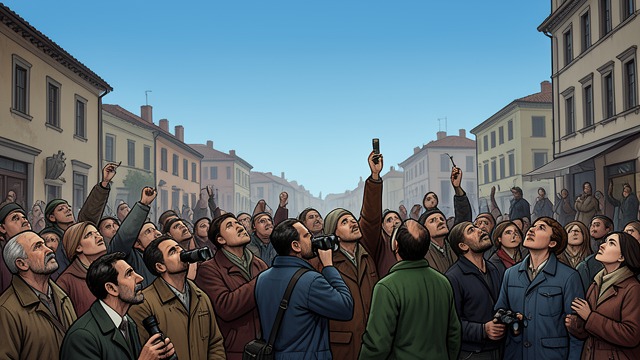
Social Proof in the Street
A Growing Audience
Stanley Milgram, Leonard Bickman, and Lawrence Berkowitz had people look toward an empty sky. As the number of observers increased, more passersby stopped and looked up as well.
The pedestrians were not necessarily yielding to direct pressure. They inferred that many people looking at the same place must have evidence of something worth seeing.
The Shortcut Reverses
Social proof can be a sensible response to uncertainty, because a crowd often does know something. But when everyone relies on the same visible behavior, the apparent evidence may consist only of earlier people making the same inference.
The study marks the transition from helpful imitation to a feedback loop in which popularity itself is mistaken for independent confirmation.
The Plank Road Fever

A Promising Road
Success Becomes a Signal
George Geddes promoted plank roads after building one in Salina, New York. Their smoother travel offered an appealing answer to poor local roads, and companies spread rapidly across states.
Early roads appeared to validate the idea. Each new project was evidence to later observers, who could reasonably believe that repeated adoption reflected accumulated experience.
The Hidden Weakness
The roads lasted about four years, not the eight or more years promoters had predicted. Their maintenance costs undermined the business model, and most were abandoned by the end of the Civil War.
The boom illustrates an information cascade: later decisions copied earlier apparent success, while the crucial evidence about durability took time to emerge.
The Screw Becomes Standard

Momentum for a Better Standard
A Campaign of Adoption
William Sellers promoted a standard screw design in an industry where individually made screws limited interchangeability and mass production. He targeted influential users, including the Pennsylvania Railroad and the United States Navy.
Every prominent adopter made the design seem more likely to prevail. That expectation helped draw still more users toward the standard.
A Useful Cascade
The design was considered superior to its chief competitor, and standardization helped enable industrial production. Yet its success depended on a cascade that might, in another case, have spread an inferior choice.
The episode complicates the book’s warning: imitation can efficiently transmit a good innovation, but a successful cascade is not proof that the process was reliably wise.
The Hybrid Corn Trial
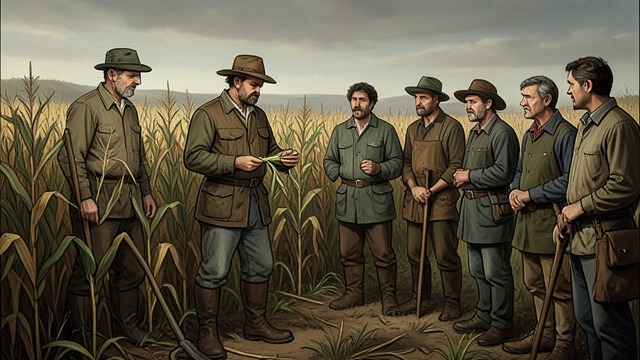
Learning Before Committing
Neighbors as Evidence
Iowa farmers heard that hybrid seed corn could increase yields substantially, yet many did not immediately adopt it. They waited to see how the crop performed on neighboring farms.
Their reliance on others’ experience resembles a cascade, but their response was not blind imitation. Farmers planted small test plots before deciding whether to change their practices more fully.
Local Verification
It took years for adoption to spread widely. That delay reflects caution, but it also let farmers compare public signals with their own land and observations.
The example distinguishes social learning from slavish conformity: a crowd can borrow evidence from others while preserving opportunities to test whether that evidence applies locally.
Early twentieth century, in the Guyana jungle
1968, during the street-corner observation study
1846 through the late 1850s
The 1860s and following decade
1930s, across nine years of adoption
